New Zealand may not know its government for weeks — key takeaways
The results in the New Zealand election are anything but clear with the two major parties — Labour and National — in the tightest of races.
In the words of Labour leader Chris Hipkins, "New Zealand has spoken", but exactly what it has said is anything but clear.
The two major parties — Labour and National — are in an exceptionally close race, showing that every vote really does count.
The National-ACT-NZ First bloc is holding on to a projected 67 of 131 seats, one more than the 66 needed for a majority, and for the moment looks to be in a marginally stronger position to form government.
But the final results are likely to come down to the count of special votes, which won't be completed for weeks.
Here's what we know so far about the New Zealand election results.
There is less than one per cent separating the two major parties in New Zealand and the direction of the vote is far from certain.
With results in from 100 per cent of voting places, the latest results suggest National is ever so slightly ahead with 29.37 per cent of the vote compared to Labour's 29.22.
But there are still an estimated 700,000 of special votes expected to be processed.
Labour Party leader Chris Hipkins told his supporters at their election night event that it would take "a little bit longer to figure out" the results than expected.
"Every vote matters and every vote must now be counted."
The opposition leader has called on parties to "work together" with results indicating a very tight race.
He's vowed to get "straight to work" if Labour manages to form government, while promising "to stand up for the people who need a strong voice in parliament".
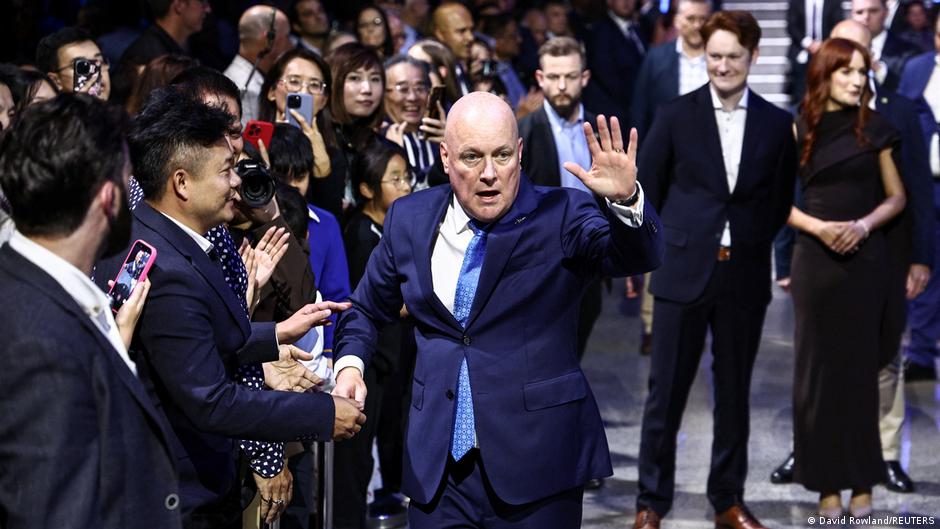
National Party leader and Prime Minister Christopher Luxon struck a humble tone, saying the election was "too close to call".
He also acknowledged that forming New Zealand's next government was likely to take some negotiation during his address to party faithful.
But he said National did appear to have a "pathway" back to government.
"It is heartening to see that, on the numbers so far, National has once again the largest party in parliament," he said.
But his party looks likely to lose some of their top-ranking ministers, including Nicola Willis, Chris Bishop and Paul Goldsmith, each of whom hold multiple portfolios.
"Negotiations and compromises are going to be required. And that is exactly as the architects of MMP [Mixed Member Proportional system] always intended to happen," Luxon said.
With Labour and National's party vote about even, it's likely the electorate seats and size of the "overhang" will be the deciding factor in who forms government.
In New Zealand elections, voters get two votes — one to elect their local MP and another to decide the number of seats a party gets in parliament. It's known as Mixed Member Proportional (MMP) voting.
If a political party wins more electorates than the seats they would be eligible for according to their general party vote, more seats are added to parliament and referred to as "the overhang".
In the past, overhang seats have generally helped parties such as Te Pāti Māori, which have won more electorates than their party vote entitles them to.
But for the first time it’s looking like a major party could create an overhang in New Zealand Parliament.
That brings us to the role of minor parties.
Neither National nor Labour will win enough seats to form government by themselves, which means they will have to turn the smaller parties to form government.
The self-described centrist party, Opportunity, under new leader Qiulae Wong looks on track to enter parliament.
It could play a key king-maker role if Luxon and his traditional allies on the right fail to secure a majority in their own right.
Claire Timperley, a Victoria University of Wellington senior lecturer in politics, told the ABC Opportunity would be the party to watch.
The Principles of the Treaty of Waitangi Bill, which sought to define the Treaty's principles in law, was defeated in 2025.
The Treaty remained a major topic of debate in this election.
More Māori voters than ever before enrolled to vote in this election and the treaty has been a major topic of conversation among many.
Whichever way the results go, the next government will inherit a Treaty debate that needs to be resolved.
Te Pāti Māori had aimed to get the government, who had worked to reduce the importance of the Treaty of Waitangi in public life, out of power.
Te Pāti Māori co-leader Debbie Ngarewa-Packer said her party could be willing to work with the Opportunity party in a coalition government.
Debbie Ngarewa-Packer held off her Labour challenger in Te Tai Hauāuru electorate in the preliminary count.
"We went into this with one objective which was to get this government out and I'm hoping that's the way the cards are going to fall," she said.
"We've just got to keep remembering that the prime minister of this last government said that he wouldn't work with Opportunity.
"I think there's an ability for all four of us [Te Pāti Māori, Labour, the Green Party and Opportunity] to work together."
There are still 700,000 special votes expected to be processed, including overseas ballots.
A new government may not form before Christmas, according to Tom Jamieson, a senior lecturer in political science at Victoria University of Wellington.
"I think we'd be pushing it to do anything before [then] in terms of having a coalition formed," he said.
"It'll be only probably until in three weeks' time when the official results are announced and all special votes are counted that we would know the exact balance of power."
New Zealanders may have spoken, but as Chris Hipkins said, working out exactly what they said is likely to take plenty of time.
- zealand
- government
- takeaway
- result
- election
- party
- labour
- national