Simon Winchester obituary
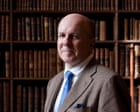
Intrepid writer and journalist who reported on the Troubles and Watergate, and whose string of bestsellers began with The Surgeon of Crowthorne The author and journalist Simon Winchester, who has died after a heart attack aged 82, thought himself lucky to have enjoyed “a pretty interesting, world-wandering life”. We first knew about the Chornobyl disaster, which hastened the end of the USSR and a new geopolitical order, because an aberrant wind allowed Swedish scientists to measure the radioactive fallout freakishly blowing from Ukraine.
Intrepid writer and journalist who reported on the Troubles and Watergate, and whose string of bestsellers began with The Surgeon of Crowthorne
The author and journalist Simon Winchester, who has died after a heart attack aged 82, thought himself lucky to have enjoyed “a pretty interesting, world-wandering life”. Those wanderings yielded a harvest of 30 books across a vast spectrum of subjects: from the land beneath to the wind above; from earthquakes to dictionaries, oceans to engines.
The globe-trotting polymath, an American citizen from 2011, loved to take an everyday “invisible thing” in culture or nature – such as the winds of his final book, The Breath of the Gods (2025) – and show how it shapes private and public histories. We first knew about the Chornobyl disaster, which hastened the end of the USSR and a new geopolitical order, because an aberrant wind allowed Swedish scientists to measure the radioactive fallout freakishly blowing from Ukraine.
Earlier in his career, Winchester had served as an acclaimed foreign correspondent who reported from Asia and the US. He remained by craft and instinct a scoop-hungry journalist who longed to chase a story to the ends of the Earth. At his death, he was planning a trip to Bolivia to research the history of silver. If any thread linked his eclectic shelf of works, it was knowledge itself: its pursuit, its costs, its profits and its transformations.
His penultimate book, Knowing What We Know (2023), followed the history of information transmission from Mesopotamian clay tablets to the dawn of the AI era. Never a nostalgist or doom-monger, he not only worried about intelligent machines “taking the strain off the brain”, but welcomed the AI-assisted chance to “sit back and reap the benefits of being once again able to think”.
Winchester himself seldom sat back. Born in London to Andrée (nee de Wael) and Bernard (a wartime PoW at the time of his son’s birth), he had – unlike most media peers – a scientific education. He managed to get himself expelled from Hardye’s boarding school in Dorset after a “spectacularly destructive” lab experiment. After hitchhiking in North America, he studied geology at St Catherine’s College, Oxford. Through the university’s Exploration Club, he enjoyed the first of the (sometimes perilous) adventures that punctuated his career. Stranded in Greenland, and weighed down with rock samples, he and his fellow students had to trek across pack ice to await rescue by a frail Cessna flown in from Reykjavik.
Geology secured Winchester a job with Falconbridge, a Canadian mining company. But in the mountains of Uganda, in 1967, he read James Morris’s book Coronation Everest “in one sitting in my tent, and underwent a classically Pauline conversion”. Now he would dig for stories, not rocks. He wrote to James (later Jan) Morris, who encouraged him, and became a lifelong friend.
Winchester moved to Newcastle as a reporter for the local daily newspaper, the Journal, and soon specialised in science. In 1969 he joined the Guardian as a regional correspondent, but it was his posting to Northern Ireland during the Troubles that made his professional name. Honoured as UK Journalist of the Year in 1971, he later regretted acting as a key, unwitting conduit for army disinformation fed him by Brigadier Frank Kitson. Still, he saw his eyewitness reports on the 1972 Bloody Sunday killings – which contradicted official versions – vindicated much later by the Saville inquiry.
From Belfast he went to Kolkata to cover the Bangladesh independence war. After 1972, he began his immersion in US politics and society as Washington correspondent with a front-row seat for the Watergate affair and the downfall of Richard Nixon. In 1974, Faber published his book about conflict in Northern Ireland, In Holy Terror. He drove overland to New Delhi in 1977 with his young family: he had married Judith Brown in 1966, and they had three sons. His Indian posting deepened the Asian interests that would prompt later books: with Morris, he collaborated on Stones of Empire (1983), about the architecture of the Raj.
After an unhappy American interlude on the Daily Mail and a move to the Sunday Times, he extended his war zone experience to the Falklands conflict in 1982. Imprisoned by Argentinian authorities for three months in Tierra del Fuego (the source of his Prison Diary, 1983), he recalled that “I went to an English boarding school, so it was very easy for me.” Later he reported from the wars of the Balkans, and returned to the region for his 1999 volume The Fracture Zone.
In 1985 another epic journey – this time by train – took him to Hong Kong, his base until the colonial territory’s transfer to China in 1997. He flourished there: he reported for the Guardian, wrote for Condé Nast Traveler magazine, and started to explore “the immense enigma that is China”. Books inspired by his stay included Pacific Rising (1991), Hong Kong: Here Be Dragons (1994), and a favourite title: the record of a 4,000-mile journey along the Yangtze titled The River at the Centre of the World (1996).
As a writer-adventurer in Asia, he never courted danger, although sometimes it did find him: as when, on Mount Pinatubo in the Philippines, he kayaked into a newly created volcanic lake only to find his vessel melting underneath him.
Now a permanent freelancer, he settled in New York. In 1998, his book on a seemingly fringe tale of a delusional American doctor who had killed a man, and his contribution to the creation of the Oxford English Dictionary, improbably stormed the charts. It converted a book-writing journalist into a serial bestseller. The Surgeon of Crowthorne (or in the US, The Professor and the Madman) won glowing reviews for the bizarre but moving tale of its Broadmoor-incarcerated protagonist, William Chester Minor. Its author modestly said that a rave in the New York Times only shifted so many copies because it appeared on a rainy Labor Day. Whatever the reason, its success bore the Winchester trademark of zestful but precise storytelling about a hunt for understanding – in this case, lexicography – that illuminates a wider world. In 2019, Sean Penn and Mel Gibson starred in a film adaptation.
After his first marriage ended in divorce, Winchester married Catherine Evans in 1989. That marriage ended in 1998; in 2007, the ceramicist, photographer and former NPR producer Setsuko Sato became his third wife. As well as his three sons, Rupert, Angus and Alex, he had a daughter, Harriet, from another relationship.
He and Sato lived on a farm in the small town of Sandisfield, Massachusetts, where he kept bees, made cider, and (from 2010) ran a local newspaper, the Sandisfield Times. Appointed OBE in 2006, and made a fellow of learned societies in the UK, US and Canada, he won a more local honour as the elected moderator (mayor) of Sandisfield in 2017.
Through the first two decades of this century he published a sequence of well-researched, reader-friendly books. They roamed far and wide over science, history and culture, blending his limitless curiosity with tireless fluency. From The Map that Changed the World (2001) and Krakatoa (2003) to Atlantic (2010) and a history of precision engineering, Exactly (2018), quests for knowledge often drove this work. His heroes included engineers, explorers, etymologists and trailblazing scholars such as the great sinologist Joseph Needham, on whom he wrote The Man Who Loved China (2008).
Trim, vigorous, busy to the point of hyperactivity, Winchester had a paradoxical fondness for the capybara – that plump and indolent South American rodent. His far-flung enthusiasms and hectic schedule rested on loyal support from his regular publishers, HarperCollins, whose publishing director Arabella Pike praised him as “irrepressible, kind and a genius storyteller”. He bothered to nurture newcomers. The writer Rose George, for example, contacted him when studying Northern Ireland and promptly received help.
In addition to his planned Bolivian project, Winchester left behind an unfinished memoir. The writer who loved “being in Scotland west of the Caledonian canal” and “being at sea anywhere” wished to have his ashes scattered at the Corryvreckan whirlpool between the islands of Jura and Scarba.
He is survived by his wife and children.
- simon
- winchester
- wind
- obituary
- journalist
- book
- writer
- troubles