As Trump arrives in China, low expectations for breakthroughs in rivalry

Analysts expect few concrete outcomes from talks between the leaders on the sidelines of the APEC summit.
For more than a year, the United States and China have maintained an uneasy truce in their intense technological and economic rivalry.
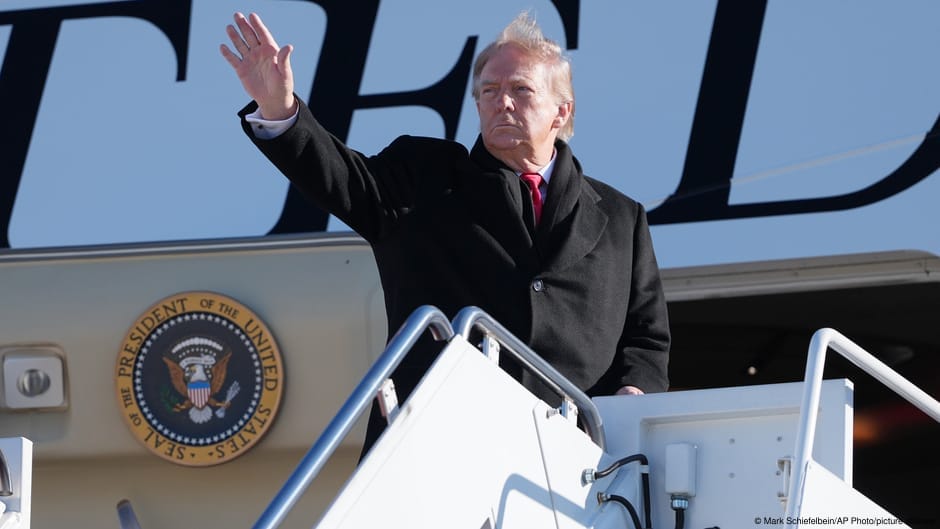
As US President Donald Trump landed in Shenzhen on Wednesday for his third meeting with Chinese counterpart Xi Jinping since hitting pause on the US-China trade war last year, expectations for major breakthroughs are low.
At the Shenzhen airport, Xi greeted Trump — Chinese presidents rarely welcome visiting guests when they land — even as journalists travelling with the US president waited on Air Force One.
Yet despite the red carpet welcome, analysts expect few concrete agreements out of Trump and Xi’s meeting on the sidelines of the Asia-Pacific Economic Cooperation (APEC) summit in Shenzhen, China, on Thursday.
Instead, the two leaders are expected to focus on stabilising ties between Washington and Beijing at a time when their differences are in full view amid claims that chip giant Nvidia’s former CEO was targeted in a Chinese espionage operation.
Trump and Xi each benefit from “projecting a sense of having things under control in the US-China relationship,” said Ryan Hass, director of the John L Thornton China Center at Brookings.
“I do not expect that dynamic to change in the coming period,” Hass told Al Jazeera.
“Their ability to continue to guide the relationship will be challenged in the coming year, though, since they will not have as many opportunities for direct leader-level diplomacy as they did in 2026,” he added.
Ahead of the talks, Trump has sought to downplay the controversy surrounding Nvidia, which revolves around former CEO Jensen Huang’s relationship with a Megaspeed executive accused of being a Chinese spy.
The scandal has highlighted tensions within the Trump administration over China’s access to AI chips amid suspicions that Megaspeed, a data centre company based in Singapore, diverted Nvidia GPUs to the country in violation of US export controls.
On Monday, US prosecutors confirmed that it had opened a criminal investigation into Megaspeed amid recriminations over the US Department of Commerce’s failure to place the firm on its export control list.
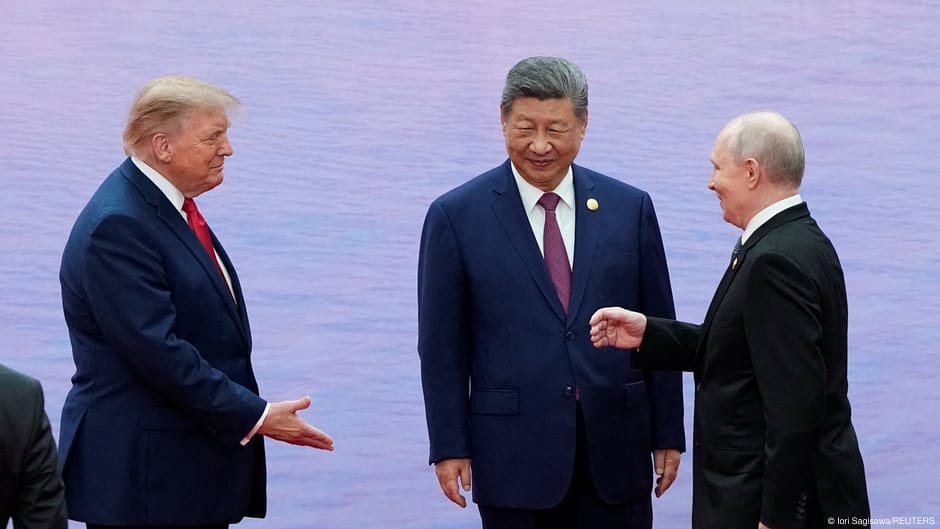
“We’re heading to China, and I don’t think you want to insult China just before you get there,” Trump, who will also join an unprecedented three-way meeting involving Xi and Russian President Vladimir Putin at APEC, told reporters on Monday.
Beijing has denied the spying claims, calling them “entirely groundless” and “intended to smear and malign China”.
Rana Mitter, S T Lee Chair in US-Asia relations at the Harvard Kennedy School, said he expected “little mention” of Nvidia in public.
“China denies involvement, and Trump has stated that he doesn’t intend to raise it,” Mitter told Al Jazeera.
“Also, the US administration is still divided on the best course of action,” he said.
“Overall, the Trump administration will look to maintain the current detente, but the underlying competition remains strong.”
Trump and Xi have held three face-to-face meetings aimed at lowering the temperature in the US-China rivalry since the US president kicked off a renewed trade war against Beijing upon his return to the White House.
Amid tit-for-tat trade salvoes, tariff rates for Chinese and US goods rose as high as 145 percent and 125 percent, respectively, until Trump and Xi agreed to a trade truce in Busan, South Korea, in October last year.
The truce is currently set to expire on January 10, 2027, after Washington and Beijing agreed to extend the agreement beyond its original expiration date of November 10.
Speaking at the opening of the two-day APEC summit on Wednesday, Xi reiterated Beijing’s opposition to protectionism and unilateralism, urging countries to support “free and open trade and investment” and “inclusive and balanced development”.
“The primary focus of this meeting is the management of risks among major powers; it does not aim to produce any groundbreaking, sweeping agreements,” Wang Wen, dean of the School of Global Leadership at Renmin University of China in Beijing, told Al Jazeera.
“China’s primary expectation is to steer major power relations back toward a path of mutual respect and peaceful coexistence, preventing a slide into a Cold War-style bloc confrontation,” Wang added.
While Trump and Xi’s September meeting in Washington was heavy on pomp and ceremony, it produced only a handful of tangible outcomes, apart from the truce extension, including commitments to establish a communication channel for AI-related security incidents and lower tariffs on $60bn worth of goods.
Among the major outstanding areas of contention is China’s restriction of rare earth exports to the US, which remain about 75 percent below normal levels, according to the Washington-based Center for Strategic and International Studies.
Deborah Elms, head of trade policy at the Singapore-based Hinrich Foundation, said the once “reasonably high” expectations for the talks had been dimmed by recent events.
“Now, particularly with the midterm election results and Nvidia fallout, if they manage to shake hands without incident, it will be viewed as a win,” Elms told Al Jazeera.
“Part of the issue on the US side is growing uncertainty about US positions. The Nvidia chip movement has broken open disagreements among Trump’s own team,” Elms said.
With a new crop of US lawmakers entering Congress in January, Elms added, “there is also no clarity on what the Democrats might want to see happen and I think the returning Republicans are also less clear about how closely to align with Trump on China”.
With Trump and Xi only expected to talk for about two hours, they will have much less time to hash out issues than during previous meetings and are unlikely to announce an extension of the trade truce at the summit, said Dennis Wilder, a former US national security official who is now an adjunct professor at Georgetown University.
“There are many protocol events, thus the time is very limited to a few topics,” Wilder, who worked on China at the CIA and the White House’s National Security Council, told Al Jazeera.
“The Chinese will voice their concerns over new export controls on high technology, the US will voice concerns that China is not lifting up to agreements on agricultural imports and rare earth exports,” Wilder said, adding that discussions would likely address AI generally but not touch on the Nvidia scandal.
“Trump’s goal is to continue the strategic stability that he and Xi announced at the Washington summit,” he added.
- trump
- china
- rivalry
- expectation
- breakthrough
- analyst
- outcome
- talk