Nigeria’s politics of fear: Who profits when democracy bleeds?, By Jude Dike

Nigeria’s 2027 general elections must not become an auction in which political influence is purchased with intimidation and young lives… If a politician needs armed supporters to make his political argument convincing, what exactly is he offering the country?.. If citizens cannot safely support opposing candidates, how can we expect them to enjoy the freedom
Nigeria’s 2027 general elections must not become an auction in which political influence is purchased with intimidation and young lives… If a politician needs armed supporters to make his political argument convincing, what exactly is he offering the country?.. If citizens cannot safely support opposing candidates, how can we expect them to enjoy the freedom to question their eventual government?
Nigeria is approaching another general election, but something more troubling than the contest for political power is already unfolding: the growing normalisation of political violence.
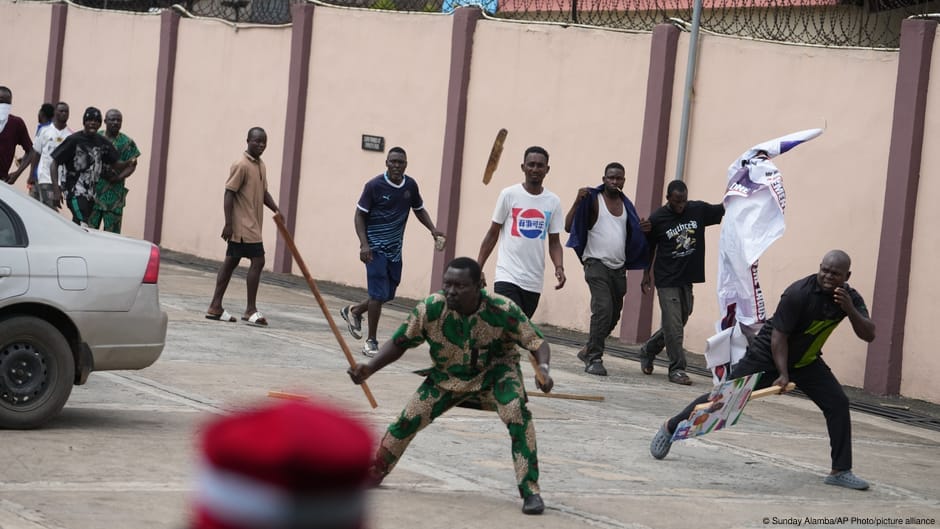
On 12 November, a political gathering in Lagos organised by supporters of Peter Obi was reportedly disrupted by men armed with axes, clubs and machetes. Journalists were attacked, equipment was reportedly stolen, and the streets became a theatre of political hostility. The APC denied allegations of involvement. Those allegations require investigation, not political assumptions.
But one question deserves to survive beyond the headlines: Who is paying for Nigeria’s growing politics of fear?
The National Peace Committee’s monitoring report, covering 19 August to 27 October recorded 109 breaches of the National Peace Accord across 26 states and the FCT. Thirty-three involved political violence and thuggery. Another 15 involved intimidation and threats.
These are not merely campaign statistics. They are early warnings about the cost of doing democracy in Nigeria.
When political supporters attack one another, the immediate headlines concern arrests, injuries and accusations. But nobody calculates the economic damage.
The trader whose shop closes during a violent rally loses income. The transport operator loses fares. The event organiser loses money. The journalist loses equipment and working hours. The injured worker loses productive days. Businesses reconsider investing in communities where political gatherings can become security emergencies.
This is Nigeria’s invisible violence tax.
We are struggling to create jobs, expand small businesses and attract investment, yet we are tolerating a political environment that destroys the very conditions businesses need to survive.
The most disturbing part is the recruitment of young Nigerians into this arrangement.
Why is it easier for some political actors to mobilise young people for street confrontations than to mobilise the same energy for employment, entrepreneurship and community development?
Most unemployed young Nigerians are peaceful. Poverty does not automatically produce violence. But economic vulnerability can become an instrument in the hands of political financiers.
And here lies the uncomfortable question: Would the politicians who finance political intimidation willingly send their own children to carry the weapons?
Political violence has an economic logic. Intimidation can weaken opponents, disrupt meetings and create territorial dominance. Those who benefit politically may never appear at the scene of an attack… The young people on the streets, however, carry the physical and legal consequences… I call this the violence dividend: political advantage enjoyed by those who deploy intimidation, while the financial and human costs are transferred to ordinary citizens.
The Politicians Get the Dividend. Nigerians Get the Bill
Political violence has an economic logic. Intimidation can weaken opponents, disrupt meetings and create territorial dominance. Those who benefit politically may never appear at the scene of an attack.
The young people on the streets, however, carry the physical and legal consequences.
I call this the violence dividend: political advantage enjoyed by those who deploy intimidation, while the financial and human costs are transferred to ordinary citizens.
And this problem is not restricted to rival parties. Internal struggles over nominations, party structures and political influence can also turn members of the same political organisation against one another.
When political ambition becomes a reason to attack fellow party members, democracy has become hostage to political intolerance.
The Law is Already There. Where is the Enforcement?
Nigeria does not need another declaration of commitment to peaceful elections.
The Electoral Act 2026 already provides important protections.
Section 95 establishes police responsibilities for securing political rallies and processions.
Section 96 addresses abusive and inflammatory campaign conduct.
Section 97 prohibits threats and violence intended to compel support for or opposition to a political party or candidate.
Section 120 criminalises disorderly conduct intended to disrupt political meetings and the possession of offensive weapons at such meetings.
The Constitution also guarantees freedom of association under Section 40 and freedom of movement under Section 41.
These are not privileges granted by political godfathers. They are rights guaranteed to citizens.
The Inspector-General of Police should activate dedicated electoral violence investigation teams in identified flashpoint states… Investigations must follow the money. Arresting the person carrying a machete while ignoring credible evidence about whoever financed the operation is treating the symptom while protecting the disease.
The immediate solution is straightforward.
INEC and the police should establish a publicly accessible electoral violence incident register. Every credible report should be tracked from investigation to prosecution.
The Inspector-General of Police should activate dedicated electoral violence investigation teams in identified flashpoint states.
Investigations must follow the money. Arresting the person carrying a machete while ignoring credible evidence about whoever financed the operation is treating the symptom while protecting the disease.
Political parties must discipline members implicated in violence where evidence establishes responsibility, while ensuring that allegations are never substituted for proof.
And security must be provided equally, whether the gathering belongs to the ruling party or the opposition.
Nigeria’s 2027 general elections must not become an auction in which political influence is purchased with intimidation and young lives.
If a politician needs armed supporters to make his political argument convincing, what exactly is he offering the country?
If citizens cannot safely support opposing candidates, how can we expect them to enjoy the freedom to question their eventual government?
Political loyalty should never cost anyone their life, freedom or future.
A country cannot build an economy with the same hands it pays to destroy its democracy.
The politicians are contesting for power. But the rest of us are paying for the contest.
And this time, Nigerians should insist on seeing the bill.
Jude Dike is a Nigerian-Canadian economist, public policy analyst, and best-selling author.
- nigeria
- fear
- democracy
- jude
- dike
- politic
- election
- auction