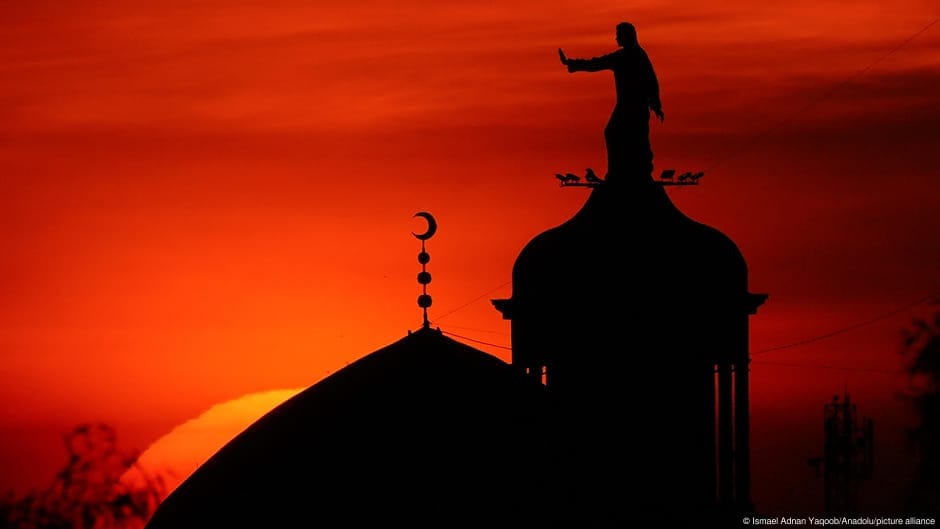
Pew Research: Islam on track to become world’s largest religion by 2035

Islam on track to become world’s largest religion by 2035. The report projects steady increases for both Christianity and Islam from 2020 to 2070.
Islam will soon be the world’s largest religion, taking Christianity’s place by 2035, according to the Pew Research Center.
The research organisation assessed the Muslim population’s expected growth in a report released on Tuesday, which projected that both groups will see their numbers increase over the next few decades.
However, the Muslim population will “simply [grow] at a faster pace,” the report said.
The projection analysed 201 countries and territories, accounting for 99.98 percent of the population, and spanned the geographic distribution and future changes of seven religious groups and affiliations – Muslims, Christians, Jews, Hindus, Buddhists, and others – from the years 2020 to 2070.
The results are part of the Pew-Templeton Global Religious Futures Project, which seeks to analyse religious change and its impact on the world.
The organisation stressed that the findings are “not intended to predict all the ways the world could change” as several other events might occur that could impact a group’s religious affiliation, such as socioeconomic circumstances, natural disasters, and wars.
According to the report, Muslims give birth to the highest number of children, one of the factors that Pew says make them the world’s fastest-growing religious group.
Fertility rates were found to be 3.1 children per Muslim woman, while Christians, with the second-highest fertility rate, had 2.5 children per Christian woman.
A generation can typically replace itself with a fertility rate of around 2.1 children per woman.
Both groups are expected to “keep pace with the world’s overall population growth”, according to Pew.
Muslims could gain up to 1.6 billion people through natural population change, compared to 792 million people for Christians.
Muslims are expected to have much smaller losses in their community than Christians leaving or converting religions.
“The difference between the number of people who join and leave Islam is expected to result in a loss of 8 million people during the projection period, [whereas] for Christians, the net difference is a projected loss of 105 million people,” the report said.
Those who choose to depart from Christianity may not identify with a religion afterwards, including atheists and agnostics.
However, the research finds that Islam’s projected growth is not the result of people converting from Christianity: the number of Muslims projected to convert to Christianity is only “slightly greater” than the number of Christians expected to become Muslims.
Between 2020 and 2070, “most of the growth in the world’s Muslim population is projected to occur in places where Muslims already make up a majority of the population”, said Pew.
By 2070, Muslims will make up 95 percent of the population in the Middle East-North Africa region. Meanwhile, in the Asia-Pacific region, Muslims are expected to surpass the religiously unaffiliated.
Muslims were the majority religious group in 53 countries in 2020. An additional 1.2 billion Muslims are expected to live in these countries by 2070, representing 74 percent of the projected growth of the global Muslim population.
For instance, Pakistan’s Muslim population is expected to double from 227 million in 2020 to 461 million in 2070. The country will become the world’s largest Muslim population, overtaking Indonesia, Pew said.
Christian growth will also be concentrated across 120 countries where Christians were already the majority of the population.
Overall, the population of Christians in these countries is forecast to rise by 630 million, representing 92 percent of global Christian growth.
- islam
- pew
- research
- track
- world
- religion
- report
- increase